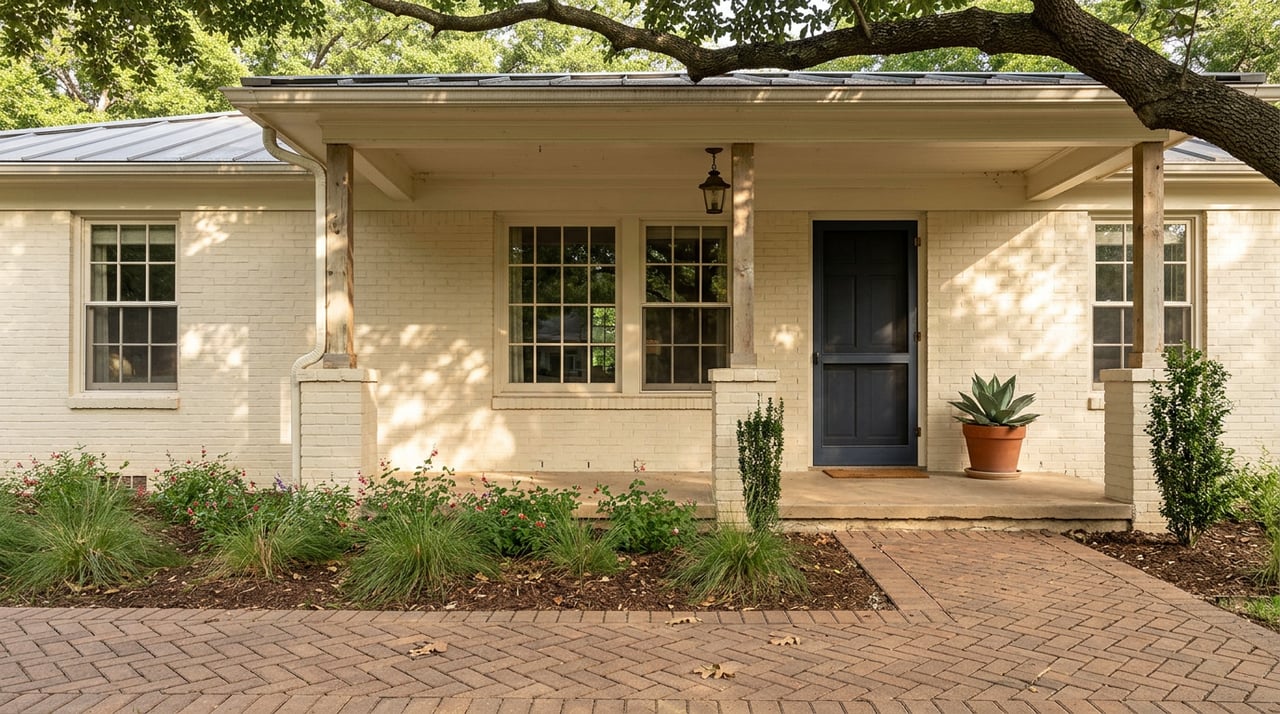
Two 1930s bungalows sit three blocks apart in Clarksville. Same era, same rough price point, same weathered wood siding and steep little front porches. A buyer touring both would be forgiven for assuming whatever renovation plan works for one will work for the other. It won't. One house can add a primary suite with a routine staff sign-off. The other has to go in front of a public commission, defend the addition on its merits, and might not get it at all. The difference has nothing to do with the price, the lot, or the listing photos. It comes down to a line on a map that most buyers never think to ask about.
Clarksville gets described, correctly, as one of Austin's oldest neighborhoods. Founded in 1871 by Charles Clark, a freedman who bought land from former Governor Elisha Pease and subdivided it for other freedmen, the district was added to the National Register of Historic Places in 1976. That's the version most people know. What gets lost is that "Clarksville" is not administered as a single regulatory zone. It's layered, and the layers change what you're allowed to do to a house you haven't bought yet.
The National Register footprint versus the pockets inside it
Most of Clarksville sits inside the Clarksville National Register Historic District, a designation that covers a wide swath of the neighborhood. But nested inside and along the edge of that footprint are at least two much smaller, separately designated local historic districts: Harthan Street, a single block running from West 6th to West 7th with roughly ten houses, and Castle Hill, a 39-acre pocket bounded by West 12th, West 6th, Baylor Street, and Shelley Street. Austin currently maintains eight local historic districts citywide, and these two happen to sit inside Clarksville's boundaries.
The distinction matters because National Register status and local historic district status carry different weight under Austin's Land Development Code. Alterations to a contributing structure anywhere in a National Register district, including replacing siding, windows, or roofing, generally require a Certificate of Appropriateness from the city before work begins. That part is consistent across both layers. Where they diverge is demolition. Inside a local historic district like Castle Hill or Harthan Street, tearing down a contributing building faces a genuinely high bar of protection. Inside the broader National Register footprint on its own, the Historic Landmark Commission can ask an owner to document the structure, encourage rehabilitation, or push for a documentation package before releasing a demolition permit, but it does not hold the same final say. A property inside the local district pocket and a property forty feet outside it, both labeled "Clarksville" on a listing, can face materially different odds if a buyer's plan involves anything more than paint.
Contributing or not: the second question nobody asks
Layered on top of which district you're in is a second classification that applies within any of them: whether a specific structure is "contributing" or "non-contributing" to the district's historic character. A contributing building is generally at least 50 years old, was built during the district's period of significance, and retains a high degree of architectural integrity. A non-contributing building either postdates that period or has been altered enough to lose that integrity, whether through a modern addition, replacement windows, or a remodel that erased the original detailing.
This status is not a formality. Design standards apply to contributing structures. They do not apply to non-contributing ones, except in the narrow case where an owner wants to restore a non-contributing house back to contributing status, which unlocks its own incentives. So a buyer evaluating two houses of similar vintage on the same street needs to know which one has already lost its contributing status through a prior owner's renovation choices. The house that looks more "done" might actually be the one with fewer strings attached.
A 2025 case makes the mechanism concrete, and it's still the clearest local reference point available. A Historic Landmark Commission agenda from that year listed the following item for a property inside the Clarksville National Register Historic District:
HR-2025-023066, 1820 W. 10th Street, Clarksville National Register Historic District: proposal for partial demolition, an addition to the existing house, and new construction of a two-story unit.
That's a real address going through real review, not a hypothetical. A more recent agenda, from March 2026, shows the same pattern playing out just across the neighborhood line in the Old West Austin National Register district, with a proposal at 1611 Preston Avenue to reconfigure the front elevation and add a second story, and a separate request at 1508 Pease Road to construct an entirely new residence. None of these are unusual. They're the ordinary traffic of a west-side Austin market where a meaningful share of the housing stock sits inside some form of historic review, and where the scope of what's approvable depends on facts specific to that parcel.
The tax abatement almost nobody uses
Here's the part that should change how a buyer thinks about the cost side of this equation. If you rehabilitate a contributing property inside one of Austin's local historic districts, the city will abate 100% of the city's portion of the property taxes on the added value from that work, for seven years if you live in the home or ten years if it's income-producing. To qualify, at least 5% of the pre-rehabilitation value has to go toward exterior work, and the abatement only covers the city's share. It does not touch the Austin ISD or Travis County portions of the bill.
That's real money on paper. In practice, almost nobody claims it. A 2023 citywide accounting found that across all eight local historic districts combined, only five properties applied for the abatement that year, for a total of $23,843 in abated value. Individual abatements ranged from $300 to $10,100, with a median around $4,000, which works out to roughly $400 a year over a full ten-year term. On a Clarksville home where price per square foot has been reported north of $600 in some recent readings, a few hundred dollars a year in city tax relief is not going to change anyone's offer strategy. But the low participation number tells you something else: most eligible owners either don't know their property qualifies, don't know the district line runs through their block, or decide the paperwork isn't worth chasing for a benefit that size. If you're planning a substantial rehab on a contributing house inside Harthan Street or Castle Hill specifically, it's worth asking your agent or the city's Historic Preservation Office whether you'd qualify before you finalize a renovation budget, since it's one of the only Clarksville-specific costs that runs in the buyer's favor rather than against it.
Why the median price you saw is probably wrong
The same small-sample problem that keeps the tax abatement mostly unclaimed also distorts the headline number every buyer anchors on first. In the most recent 30-day window one national data aggregator tracked, Clarksville showed a median sale price of $715,000 across just three closed sales, down more than 70% year over year, a swing that size in a market that thin is a sample artifact, not a trend. A different tracker's most recent full month, December 2025, showed a median of $760,000, down 36% year over year, on its own small count. A separate industry read of ACTRIS MLS data, current as of July 2026, pulled a full trailing 12 months and put the median closer to $1.47 million across 28 closings, a number built on enough volume to mean something. Three sources, all describing the same neighborhood in roughly the same window, landing anywhere from $715,000 to $1.47 million.
None of these sources are wrong exactly. They're measuring different windows on a market too small to support a stable monthly median. Clarksville's housing stock itself spans that range honestly, with reported sale sizes running from under 700 square feet to nearly 4,000, so a three-sale month can easily be dominated by whichever end of that spectrum happened to close. If you're comparing Clarksville to another Central Austin neighborhood on price, look at the trailing 12-month figure and the closing count behind it, not whatever number a single portal is showing you this week.
Before you write an offer in Clarksville
- Ask whether the specific property sits inside Harthan Street, Castle Hill, or the broader Clarksville National Register footprint. The city's Historic Property Viewer can confirm this.
- Ask whether the structure is listed as contributing or non-contributing. This determines whether your renovation plan needs a Certificate of Appropriateness at all.
- If your plan includes any demolition, ask specifically whether the parcel is in one of the local district pockets, where the bar for approval is materially higher.
- If a substantial exterior rehab is part of your plan, ask about the city's tax abatement eligibility before you finalize your renovation budget.
- Treat any single portal's median price as a snapshot, not a verdict. Ask for the trailing 12-month closing count behind it.
A few direct questions
Does National Register status mean I need city approval to repaint my house? No. Design standards in Austin's historic districts do not reach interior work or paint color choices. Review is triggered by exterior architectural changes to a contributing structure, things like windows, siding, roofing, additions, and demolition.
How do I actually find out if a house is contributing or non-contributing? It's public record. The City of Austin's Historic Preservation Office maintains a Historic Property Viewer, and staff can confirm a property's status directly if the online tool doesn't answer it cleanly.
If I buy a home mid-way through its tax abatement period, do I keep the benefit? Yes. The abatement transfers to a new owner for whatever years remain in the original term, but the new owner has to file an annual request with the Travis Central Appraisal District to keep it active.
Clarksville rewards buyers who ask the second and third question, not just the first one. If you're weighing a Clarksville property against something in Tarrytown or Old Enfield and want a clear read on what a specific address can and can't do before you write an offer, I'm happy to walk through it with you. Let's Connect.